
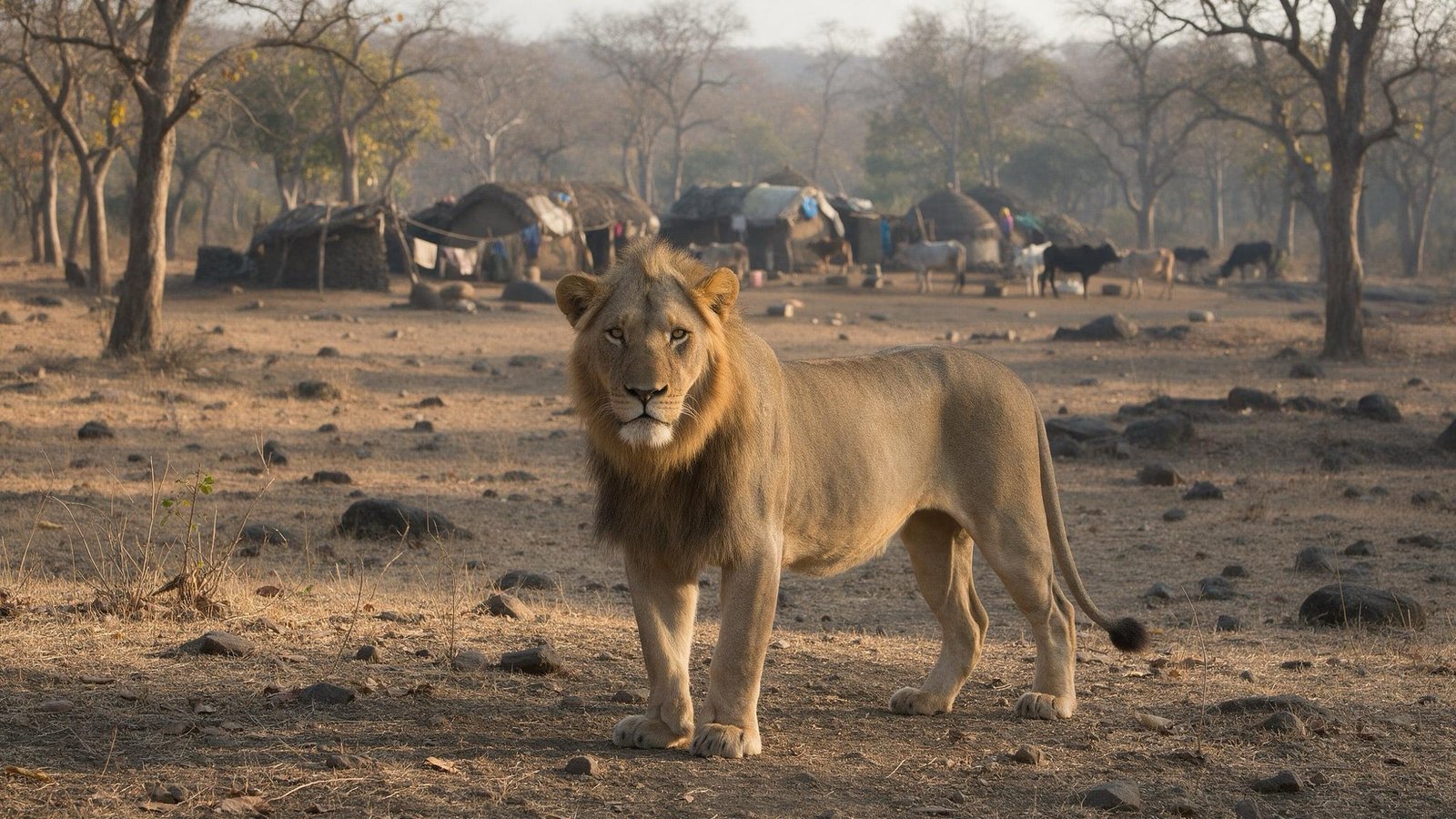
The Gir Lion and the Maldhari: A Story of Two Neighbours Sharing One Forest
Ask most people what Gir Forest is famous for, and they’ll say lions. And
they’re right — this dry, scrubby corner of Gujarat in western India is
the only place left on Earth where wild Asiatic lions still roam. But
spend a little time here and you’ll notice something the postcards
don’t show you: there are people living inside this forest too. Not
visiting. Living. Herding cattle a stone’s throw from lion territory,
the way their families have for generations.
These are the Maldhari — a pastoral community whose entire life is built
around their animals. And their relationship with the lion isn’t
something you can sum up in one line. It’s part fear, part faith, part
hard economics, and part quiet, everyday respect. This is their story.
So Who Exactly Are the Maldhari?
The name itself gives it away. “Mal” means livestock, and “dhari” means
one who keeps or holds something — so a Maldhari is, quite literally, a
keeper of livestock. Communities like the Rabaris and Bharwads make up
much of this pastoral population around Gir, and cattle are basically
the centre of their world: milk, income, status, everything.
They don’t live in ordinary villages. Their settlements are called
“nesses” — small clusters of mud-and-thatch homes, cattle pens, and a
shared water point, tucked right into the forest itself. Life there runs
on the forest’s clock. Everyone’s up before sunrise, cattle go out to
graze, milk gets collected, and all day long, ears stay tuned for the
sound of a lion nearby.
How Did People and Lions End Up Sharing the Same Land?
It wasn’t planned — it just happened, over a very long time. Herders
needed grazing land, and the forest happened to be home to lions too. So
for generations, cows and lions have used the exact same hillsides,
the same waterholes, the same shade.
Naturally, lions sometimes take a cow. Anywhere else in the world, that
kind of loss might trigger poisoning or hunting of the predator. In Gir,
that mostly doesn’t happen — a mix of old cultural respect, legal
protection for the lions, and the Maldharis’ own dependence on this
particular forest has kept an uneasy but real peace going.
That said, don’t romanticise it too much. It’s not a fairytale.
Livestock losses hurt real families financially, grazing land is limited,
and close encounters do happen. Coexistence here is real, but it’s also
hard-earned.
How the Maldhari Actually See the Lion
Here’s the part that surprises most visitors: many Maldhari don’t see
themselves as living with lions — they see themselves as living
in the lion’s home. That single shift in perspective changes
everything about how they behave around these animals.
Knowledge about lions here isn’t learned from a book. It’s passed down —
a grandmother teaching a grandchild what a certain low growl means, what
fresh pugmarks near the cattle pen mean, which routes to avoid at dusk.
For many families, the lion isn’t just wildlife. It’s part of what makes
them who they are, tied up with Gir and the wider Saurashtra region
itself.
- The lion is treated as the forest’s rightful resident, not an intruder.
- People are taught, early on, not to provoke or chase it.
- It carries real cultural weight — a symbol of the land itself.
- Yet none of this erases the real financial sting when a cow is lost.
Cattle, Lions, and a Complicated Food Chain
Here’s where it gets genuinely complicated. When a lion kills a cow or
buffalo, it’s not a small thing for that family — that animal was milk,
income, and often years of careful breeding, gone in a night.
But researchers who’ve studied Gir closely have also found that
livestock plays into the lions’ survival too. In some areas, cattle
grazing keeps the undergrowth open, which actually shapes how and where
lions hunt. It’s a strange, tangled relationship — too much grazing
stresses the land, but the pastoral economy and the forest’s ecology are
still knitted together in ways that aren’t easy to untangle.
- Families do lose cattle to lions — that’s a real cost, not a footnote.
- Lions, in turn, sometimes rely on that livestock as an easy meal.
- Grazing patterns shape the vegetation lions hunt through.
- Maldhari knowledge of the land is genuinely valuable to conservation.
- Too much grazing can still put pressure on the wider habitat.
Beliefs, Rituals, and the Stories Passed Down
It would be misleading to say every Maldhari family follows one fixed
ritual around lions — beliefs shift from community to community, even
family to family. But a few threads run through most of them.
A Kind of Everyday Respect
If a lion turns up near a settlement, the instinct isn’t to chase it off
or make noise — it’s to stay calm and give it space. Part tradition,
part plain common sense: provoking a lion rarely ends well.
Making Peace With Loss
When a cow is taken, some families speak of it almost as the forest
claiming what belongs to it — a way of processing an unavoidable part of
life here. That doesn’t make the loss painless. Compensation still
matters enormously to these families.
Sacred Trees, Springs, and Village Gods
Many pastoral communities across this part of Gujarat hold certain
trees, water sources, or patches of forest as sacred, tied to local
deities and guardian spirits. It’s less a single “lion religion” and
more a whole worldview where the forest itself is treated with care.
Stories Around the Fire
Almost everything a young Maldhari learns about lions comes through
stories told by elders — how to read a pugmark, recognise a call, or
choose a safer path for the herd. It’s an oral inheritance, and it’s
quietly one of the most valuable things this community holds.
What Daily Life in a Ness Actually Looks Like
- Cattle head out for grazing at first light.
- Milk is collected and prepared for sale or home use.
- Shelters and pens are checked and maintained.
- Children grow up learning animal care almost as soon as they can walk.
- Everyone stays alert to signs of lions and other wildlife nearby.
- News — good or worrying — travels fast between neighbouring nesses.
It’s easy to romanticise this kind of life from the outside. In reality,
living inside a protected forest also means limited access to schools,
hospitals, and roads — real trade-offs that come with this way of life.
When a Lion Takes Livestock: The Question of Compensation
Losing a cow or buffalo to a lion isn’t just sad — it’s a genuine
economic blow to a family. Studies on Gir have shown that fair, timely
compensation makes a real difference: it takes some of the sting out of
the loss and helps keep resentment toward lions from building up.
- Faster verification when livestock is lost
- Compensation paid without long delays
- Veterinary help and rescue support when needed
- Stronger, safer cattle enclosures
- Better lighting around homes and pens at night
- Simple early-warning systems between neighbouring nesses
- A real seat at the table for Maldharis in conservation decisions
The Difficult Question of Relocation
Over the years, some Maldhari families have been moved out of the core
forest area to settlements outside it, mainly to ease pressure on lion
habitat and give families easier access to schools and healthcare.
It’s rarely simple. Moving isn’t just about a new house — it means
leaving behind grazing land, community ties, sacred sites, and a way of
life built around this specific forest. Some families do end up better
off with schools and roads nearby. Others struggle to adjust. Either
way, it’s a decision that deserves real consultation and fair support,
not just a policy on paper.
Why Gir Matters Beyond Gir
The way Gir has worked out — imperfectly, but genuinely — offers a
lesson for conservation everywhere: people and wildlife are usually
fighting over, and sharing, the very same land. When communities only
experience restrictions and losses, they check out of conservation
entirely. When their knowledge and livelihood are respected, they become
some of the best allies wildlife could ask for.
- Solid legal protection for the lions
- A healthy, intact forest habitat
- Enough natural prey and water for lions to thrive without cattle
- Fair, quick compensation for livestock losses
- Genuine respect for Maldhari knowledge and culture
- A real voice for local communities in how the forest is managed
The Honest Truth About Coexistence
It’s tempting to tell this as a heart-warming tale of humans and lions
living in perfect harmony. That’s not quite true. Maldhari families have
genuinely lost animals, faced restrictions, and lived with real
uncertainty about their future. At the same time, they’re not a threat
to be managed — they carry knowledge of this land that no outsider could
replace.
The real story sits somewhere in between: fear and faith, hardship and
respect, all tangled together. It’s still evolving, and it depends on
communities, forest officials, and researchers continuing to work it out
together, year after year.
Planning Your Own Trip to Gir: A Quick Guide for Foreign Travellers
If reading this has made you want to see Gir for yourself, here’s the
practical side — where it is, how to get there, and where to stay.
Where Is Gir, Exactly?
Gir National Park and Wildlife Sanctuary sits in the Saurashtra region of
Gujarat, in western India, roughly in the triangle between the towns of
Junagadh, Veraval, and Una. The little town right at the park’s entrance
— and the place you’ll actually base yourself — is called
Sasan Gir. It’s a small, dusty, friendly town, not a
city, so don’t expect much beyond what tourism has built up around the
park gate.
How to Reach Sasan Gir
By air: The closest airport is Diu Airport (around 75
km away), and Keshod Airport is also fairly close (around 60 km). Both
have limited flight schedules, though, so most international travellers
actually fly into Rajkot Airport or Ahmedabad, which have far better
connections to Mumbai and Delhi, and then continue by road or rail.
By train: Sasan Gir has its own small railway station,
but it’s not well connected to major cities directly. Most travellers
take a train to Junagadh or Veraval — both around 60–80 km from Sasan
Gir — and finish the journey by taxi or bus.
By road: The roads into Sasan Gir are in decent shape.
From Ahmedabad, it’s roughly a 7-hour drive; from Rajkot, more like 3–4
hours. Shared jeeps, buses, and private taxis all run regularly from
Junagadh and Veraval.
When to Go
The park is closed every year from mid-June to mid-October for the
monsoon. The best window is December to March, when
mornings are cool and animal sightings are easier. April to June is
hot and dry, but some travellers actually prefer it — lions gather near
waterholes, which can mean better sightings, if you can handle daytime
temperatures well over 40°C.
Where to Stay — Homestays and Lodges
This is where you can actually meet Maldhari families rather than just
reading about them. A few options:
-
Village homestays near Sasan Gir — Several
Maldhari and local Gujarati families around Sasan Gir now open their
homes to travellers. These are simple, home-cooked-meal kind of stays,
and they’re genuinely the best way to hear real stories about living
alongside lions, straight from people who do it every day. -
Forest lodges and eco-resorts — Sasan Gir has a
growing number of mid-range and higher-end lodges built specifically
for wildlife tourism, many just a few minutes from the park gate, with
naturalist-led safaris included. -
Budget guesthouses — For travellers on a tighter
budget, simple guesthouses in Sasan Gir town itself are easy to find
and book on arrival or through local tour operators.
Whichever you pick, book your safari permits ahead of time if you’re
travelling in peak season (December–February) — jeep slots fill up fast,
and there’s a separate, higher entry fee for foreign nationals compared
to Indian visitors.
A Quick Tip Before You Go
If you want more than just a lion sighting from a jeep, ask your lodge
or homestay host if they can arrange a conversation with a local
Maldhari family, or a walk near (not into) a ness with a guide. That’s
where this whole story actually comes alive — not in the safari
vehicle, but in a quiet conversation with someone who has lived beside
these lions their entire life.